Enjoy discounts on herbal wellness products!
Understanding Disease Through the Endocannabinoid System: A New Perspective on Human Health
Isaiah Byrd
11/30/20254 min read
The endocannabinoid system is the most interesting part of cannabis and human health. Even without cannabis, the system is maintained by our lifestyle choices. I think focusing on this system when addressing human health is important to grasp an individuals disrupted full picture health state.
If the responsibility of this is to maintain a total balance, this system has to show signs early of disruption before a full-blown organ system failure happens and likely continues when addressed conventionally. This could mean the imbalance in the endocannabinoid system begins in the part of the body where the disease manifest or this perspective as a target for treatment. I see this pattern when I read literature on disease relation to the endocannabinoids system.
Unlike categorizing disease that is system associated, categorizing diseases from the perspective of the endocannabinoid system is organism associated where the disease would be divided based on “endocannabinoid tone.” Basically, whether the ‘endocannabinoid tone’ system is depressed or overstimulated reflects two different groups of diseases (Toczek & Malinowska, 2018).
Taking a Deeper Dive
Let’s take a dive to see if I can explain what I mean.
3 hours later…
This paper by Klawitter et al. (2025) is the most recent study I have read that greatly reflects this theory. In the paper, it reviews the changes of endocannabinoids in “joint diseases” and describes them as various arthritic disease-causing inflammation and pain. The study analyzed plasma levels of Rheumatoid arthritis (RA) and osteoarthritis (OA) patients show a drop in circulating 2-AG.
2-AG is recognize as a “key regulatory of nociception and inflammation,” and the authors suggest raising these levels could be a therapeutic approach for addressing the inflammation and pain. In this paper a common endocannabinoid 2-AG levels were lower in Rheumatoid and osteoarthritis patients (RA: ~8.2 ng/mL vs healthy: ~21.7 ng/mL).
Split ECS Signatures in Joint Disease
At the same time, RA patients showed elevated N-acylethanolamine group of endocannabinoids (AEA, PEA, OEA, etc.) than healthy controls. These are mostly FAAH substrates; the paper suggests this pattern could indicate reduced FAAH activity in RA patients which means these lipids aren’t being broken fast enough.
From the perspective of the endocannabinoid system, anandamide can activate CB1/CB2 promoting anti-inflammatory and analgesic effects but also activates TRPV1 in peripheral tissue driving pain and inflammatory signaling when overactivated. The authors caution not to assume the net effect is purely protective; it may be mixed.
This means that the high levels of the anandamide related group are possibly trying and failing to control inflammation and pain through slowing the enzyme of FAAH that degrades these compounds increase their levels.
Rethinking Arthritis: Not Just “Joints,” but ECS Tone
So, based on acute evidence in this study RA and OA are not just “inflamed joints,” they are ECS-tone expressions with split signatures:
The authors frame this as a targeting opportunity to adjust ECS tone (raise 2-AG and modulate FAAH) instead of only hammering other inflammatory pathways using opioids.
So, instead of RA being only labeled as the system associated autoimmune disorder of joints, one can say RA in treated patients expresses a characteristic ECS tone imbalance were suppressed 2-AG axis, elevated ethanolamide axis, and altered pro/anti-inflammatory is associated with these conditions.
Interestingly, these patients were already on treatment using standard-of-care drugs and ECS tone is still abnormal and pain persists. That means ECS imbalance is not just a side effect. It’s likely still active in the chronic phase and might be contributing to “residual pain” despite therapy.
Lifestyle & Omega-3 Connection
From a lifestyle perspective, they also tie lipid mediators and omega-3 status into ECS tone. RA patients had lower plasma EPA and DHA, and the paper suggests that this deficiency in anti-inflammatory lipids may worsen unresolved inflammation and persistent pain, and omega-3 supplementation or through diet may be beneficial for these “joint diseases” (Klawitter et al., 2025).
De Melo Reis et al. (2021) reviews the role dietary omega 6:3 ratio contributes to lipid mediators such as DHA and EPA that promote anti-inflammatory.
Conclusion: Rethinking Disease Through the ECS
To conclude, I am basically trying to say the ECS would demonstrate disruption early and continues through the disease course, even after conventional treatment of the named organ system. I believe Klawitter et al. (2025) backs that up in humans with RA and OA.
I will explain this in the future with more sources — but this one demonstrated my thoughts with data from actual patients, and this gets me really excited.
Future Direction...
This approach — viewing disease first as an ECS-tone signature rather than an organ-specific issue — may completely change how we understand inflammation, pain, and even chronic disease progression. The ECS may not just respond to disease, it may foreshadow it.
References
De Melo Reis, R.A., Isaac, A.R., Freitas, H.R., de Almeida, M.M., Schuck, P.F., Ferreira, G.C., Andrade-da-Costa, B.L.D.S. and Trevenzoli, I.H. (2021). Quality of life and a surveillant endocannabinoid system. Frontiers in neuroscience, 15, 747229. https://doi.org/10.3389/fnins.2021.747229
Klawitter, J., Clauw, A. D., Seifert, J. A., Klawitter, J., Tompson, B., et al. (2025). Endocannabinoid tone and oxylipins in rheumatoid arthritis and osteoarthritis—A novel target for the treatment of pain and inflammation? International Journal of Molecular Sciences, 26(12), 5707. https://doi.org/10.3390/ijms26125707
Toczek, M., & Malinowska, B. (2018). Enhanced endocannabinoid tone as a potential target of pharmacotherapy. Life Sciences (1973), 204, 20-45. https://doi.org/10.1016/j.lfs.2018.04.054
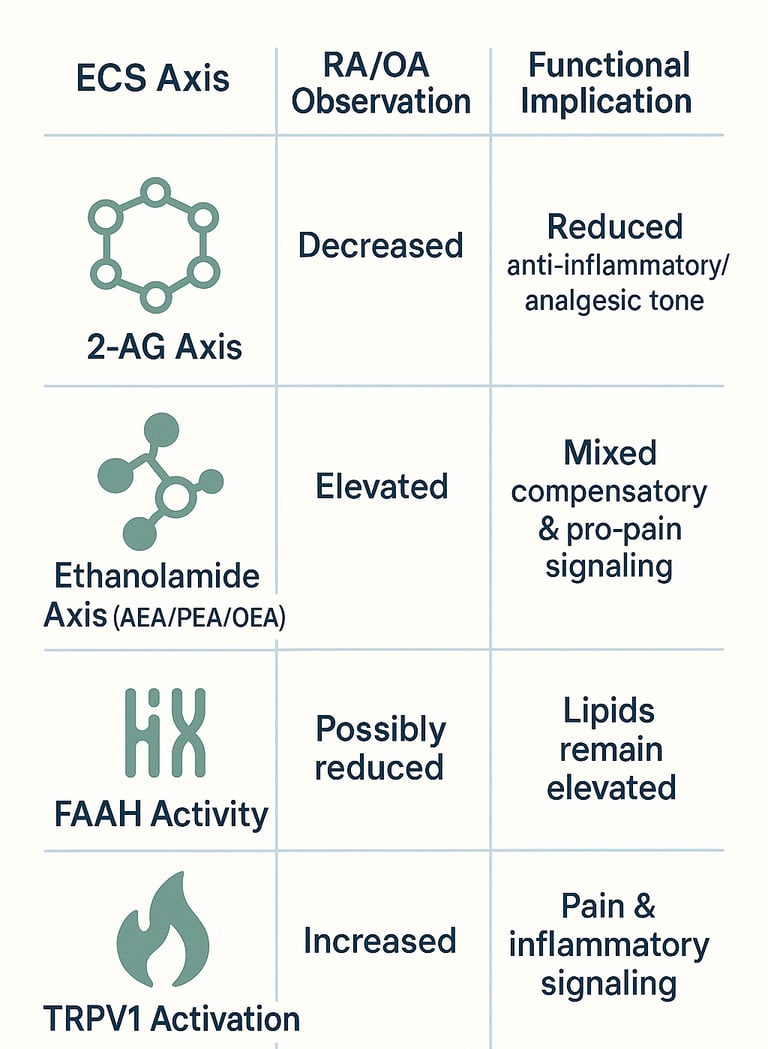
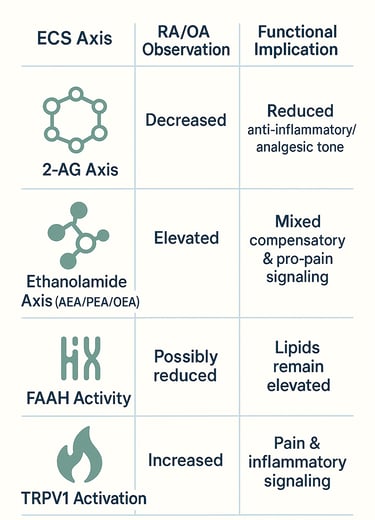

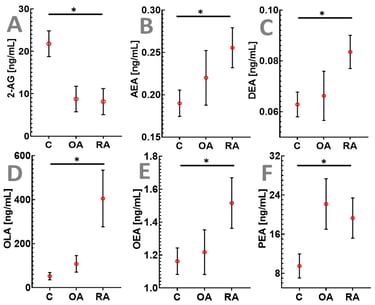
Figure 2: Changes in endocannabinoids and congeners that are broken down by monoacylglycerol lipase (2-AG) and fatty-acid amide hydrolase (AEA, DEA, OLA, OEA, and PEA) in osteoarthritis (OA) and rheumatoid arthritis (RA) compared to healthy controls (C) (Klawitter et al., 2025).
ShiftNaturally™
Empowering health through natural plant solutions.
info@shiftnaturally.org
© 2025. All rights reserved.
Disclaimer: The information provided by Shift Naturally is for educational purposes only and is not intended to diagnose, treat, or cure any disease. Consult a qualified healthcare professional before starting any new wellness program or supplement.